A Nurse Is Reviewing the Medical Record of a Client Who Has Systemic Lupus
Systemic lupus erythematosus (SLE) is an autoimmune disease. In this disease, the allowed organisation of the body mistakenly attacks healthy tissue. It can affect the skin, joints, kidneys, brain, and other organs.
The crusade of SLE is not conspicuously known. It may be linked to the following factors:
- Genetic
- Ecology
- Hormonal
- Certain medicines
SLE is more mutual in women than men past nearly 10 to 1. It may occur at any age. However, it appears most often in young women between the ages of xv and 44. In the U.s.a., the disease is more common in African Americans, Asian Americans, African Caribbeans, and Hispanic Americans.
Symptoms vary from person to person, and may come and become. Anybody with SLE has joint pain and swelling at some time. Some develop arthritis. SLE often affects the joints of the fingers, hands, wrists, and knees.
Other mutual symptoms include:
- Breast pain when taking a deep breath.
- Fatigue.
- Fever with no other cause.
- General discomfort, uneasiness, or ill feeling (malaise).
- Hair loss.
- Weight loss.
- Rima oris sores.
- Sensitivity to sunlight.
- Skin rash -- A "butterfly" rash develops in almost one-half the people with SLE. The rash is mostly seen over the cheeks and bridge of the nose. It tin can be widespread. It gets worse in sunlight.
- Bloated lymph nodes.
Other symptoms and signs depend on which part of the body is affected:
- Encephalon and nervous system -- Headaches, weakness, numbness, tingling, seizures, vision problems, memory and personality changes
- Digestive tract -- Abdominal hurting, nausea, and vomiting
- Heart -- Valve bug, inflammation of center muscle or heart lining (pericardium)
- Lung -- Buildup of fluid in the pleural space, difficulty breathing, coughing up claret
- Skin -- Sores in the mouth
- Kidney -- Swelling in the legs
- Circulation -- Clots in veins or arteries, inflammation of blood vessels, constriction of blood vessels in response to cold (Raynaud phenomenon)
- Blood abnormalities including anemia, low white claret prison cell or platelet count
Some people take but peel symptoms. This is chosen discoid lupus.
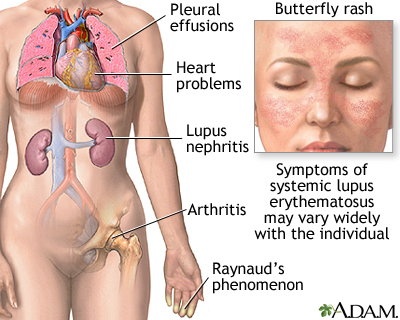
To be diagnosed with lupus, you lot must have 4 out of xi common signs of the affliction. Nearly all people with lupus have a positive examination for antinuclear antibody (ANA). Even so, having a positive ANA alone does not mean you have lupus.
The wellness care provider will practice a complete physical exam. You may take a rash, arthritis, or edema in the ankles. In that location may be an abnormal audio called a center friction rub or pleural friction rub. Your provider volition likewise practice a nervous organisation test.
Tests used to diagnose SLE may include:
- Antinuclear antibody (ANA)
- Complete blood count (CBC) with differential
- Chest x-ray
- Serum creatinine
- Urinalysis
You may also have other tests to learn more than about your condition. Some of these are:
- Antinuclear antibiotic (ANA) panel
- Complement components (C3 and C4)
- Antibodies to double-stranded DNA
- Coombs test -- direct
- Cryoglobulins
- Erythrocyte sedimentation charge per unit (ESR) and C-reactive protein (CRP)
- Kidney function blood tests
- Liver function blood tests
- Rheumatoid factor
- Antiphospholipid antibodies and lupus anticoagulant examination
- Kidney biopsy
- Imaging tests of the middle, encephalon, lungs, joints, muscles or intestines
There is no cure for SLE. The goal of treatment is to control symptoms. Severe symptoms that involve the heart, lungs, kidneys, and other organs often need treatment past specialists. Each person with SLE needs evaluation regarding:
- How active the disease is
- What role of the torso is affected
- What form of treatment is needed
Balmy forms of the affliction may be treated with:
- Nonsteroidal anti-inflammatory drugs (NSAIDs) for articulation symptoms and pleurisy. Talk to your provider before taking these medicines.
- Low doses of corticosteroids, such equally prednisone, for peel and arthritis symptoms.
- Corticosteroid creams for skin rashes.
- Hydroxychloroquine, a medicine also used to treat malaria.
- Methotrexate may be used to reduce the dose of corticosteroids
- Belimumab, a biologic medicine, may exist helpful in some people.
Treatments for more severe SLE may include:
- High-dose corticosteroids.
- Immunosuppressive medicines (these medicines suppress the immune system). These medicines are used if you take severe lupus that is affecting the nervous arrangement, kidney or other organs. They may also exist used if you do non get better with corticosteroids, or if your symptoms get worse when y'all stop taking corticosteroids .
- Medicines most normally used include mycophenolate, azathioprine and cyclophosphamide. Because of its toxicity, cyclophosphamide is limited to a short course of iii to 6 months. Rituximab (Rituxan) is used in some cases every bit well.
- Blood thinners, such as warfarin (Coumadin), for clotting disorders such as antiphospholipid syndrome.
If you have SLE, information technology is also important to:
- Wear protective article of clothing, sunglasses, and sunscreen when in the lord's day.
- Get preventive eye care.
- Stay up-to-date with immunizations.
- Accept tests to screen for thinning of the bones (osteoporosis).
- Avert tobacco and drink minimal amounts of alcohol.
The result for people with SLE has improved in recent years. Many people with SLE take mild symptoms. How well you do depends on how severe the illness is. Most people with SLE will require medicines for a long time. Nearly all will require hydroxychloroquine indefinitely. However, in the U.s.a., SLE is 1 of the superlative 20 leading causes of death in females between the ages of v and 64. Many new medicines are being studied to improve the consequence of women with SLE.
The illness tends to be more active:
- During the showtime years after diagnosis
- In people younger than 40 years
Many women with SLE can become pregnant and deliver a good for you infant. A adept outcome is more likely for women who receive proper treatment and do not have serious heart or kidney bug. However, the presence of certain SLE antibodies or antiphospholipid antibodies raises the take a chance of miscarriage.
LUPUS NEPHRITIS
Some people with SLE have aberrant immune deposits in the kidney cells. This leads to a condition called lupus nephritis. People with this problem may develop kidney failure. They may need dialysis or a kidney transplant.
A kidney biopsy is done to detect the extent of damage to the kidney and to help guide treatment. If agile nephritis is present, treatment with immunosuppressive medicines including loftier doses of corticosteroids along with either cyclophosphamide or mycophenolate are needed.
OTHER PARTS OF THE BODY
SLE can cause damage in many different parts of the body, including:
- Claret clots in arteries of veins of the legs, lungs, brain, or intestines
- Devastation of ruby claret cells or anemia of long-term (chronic) disease
- Fluid effectually the center (pericarditis), or inflammation of the centre (myocarditis or endocarditis)
- Fluid around the lungs and damage to lung tissue
- Pregnancy bug, including miscarriage
- Stroke
- Bowel damage with intestinal pain and obstruction
- Inflammation in the intestines
- Severely low blood platelet count (platelets are needed to stop any haemorrhage)
- Inflammation of the blood vessels
SLE AND PREGNANCY
Both SLE and some of the medicines used for SLE can harm an unborn child. Talk to your provider earlier you become significant. If you become pregnant, find a provider who is experienced with lupus and pregnancy.
Phone call your provider if you have symptoms of SLE. Also call if you lot have this disease and your symptoms go worse or a new symptom occurs.
Disseminated lupus erythematosus; SLE; Lupus; Lupus erythematosus; Butterfly rash - SLE; Discoid lupus
Arntfield RT, Hicks CM. Systemic lupus erythematosus and the vasculitides. In: Walls RM, Hockberger RS, Gausche-Hill M, eds. Rosen's Emergency Medicine: Concepts and Clinical Practice. 9th ed. Philadelphia, PA: Elsevier; 2018:chap 108.
Crow MK. Etiology and pathogenesis of systemic lupus erythematosus. In: Firestein GS, Budd RC, Gabriel SE, Koretzky GA, McInnes IB, O'Dell JR, eds. Firestein & Kelley'southward Textbook of Rheumatology. 11th ed. Philadelphia, PA: Elsevier; 2021:chap 84.
Fanouriakis A, Kostopoulou M, Alunno A, et al. 2019 update of the EULAR recommendations for the direction of systemic lupus erythematosus. Ann Rheum Dis. 2019;78(6) :736-745. PMID: 30926722 pubmed.ncbi.nlm.nih.gov/30926722/.
Hahn BH, McMahon MA, Wilkinson A, et al. American College of Rheumatology guidelines for screening, treatment, and management of lupus nephritis. Arthritis Care Res (Hoboken). 2012;64(6):797-808. PMID: 22556106 pubmed.ncbi.nlm.nih.gov/22556106/.
van Vollenhoven RF, Mosca M, Bertsias G, et al. Treat-to-target in systemic lupus erythematosus: recommendations from an international job force. Ann Rheum Dis. 2014;73(6):958-967. PMID: 24739325 pubmed.ncbi.nlm.nih.gov/24739325/.
Yen EY, Singh RR. Brief Report: lupus - an unrecognized leading cause of death in young females: a population-based study using nationwide death certificates, 2000-2015. Arthritis Rheumatol. 2018;lxx(8):1251-1255. PMID: 29671279 pubmed.ncbi.nlm.nih.gov/29671279/.
Updated by: Gordon A. Starkebaum, MD, MACR, ABIM Board Certified in Rheumatology, Seattle, WA. Internal review and update on 06/03/2021 by David Zieve, Medico, MHA, Medical Director, Brenda Conaway, Editorial Director, and the A.D.A.One thousand. Editorial team. Editorial update 09/xxx/2021.
Source: https://medlineplus.gov/ency/article/000435.htm

Post a Comment for "A Nurse Is Reviewing the Medical Record of a Client Who Has Systemic Lupus"